 en
en 


Call

A certificate of origin in China is a trade document used to confirm the country in which exported goods originate according to applicable rules of origin. For China-to-India air freight, it may be requested for customs purposes, trade-policy measures, buyer requirements or other regulatory reasons.
However, a certificate of origin is not automatically required for every shipment. Importers should determine whether it is needed for the specific product and transaction before cargo leaves China.
This is important because the certificate must normally remain consistent with other shipping documents, including the commercial invoice, packing list and Air Waybill. Incorrect origin information can create unnecessary questions during customs review.
A certificate of origin is documentary evidence stating that the goods described in the certificate originate in a specified country under applicable origin rules.
The basic certificate of origin meaning is therefore different from “country of shipment.” A product can be shipped from China without necessarily being Chinese in origin if it was manufactured elsewhere and only stored or redistributed through China.
The World Customs Organization defines a certificate of origin as a specific document in which an authorized body certifies that the goods covered by the certificate originate in a particular country.
Origin determination usually considers whether goods were wholly obtained in one country or whether sufficient manufacturing or processing took place there. China's own origin regulations similarly state that when several countries participate in production, the country where the last substantial transformation occurs may determine origin.
For importers, this means certificates of origin should be based on actual manufacturing facts rather than simply the supplier's address.
A certificate of origin in China is required when the importer, customs authority, trade measure or commercial arrangement needs formal evidence of the goods' origin.
Not every China-to-India air shipment requires the same origin documentation. The requirement can depend on product category, customs procedure, anti-dumping or safeguard measures, buyer policy, banking requirements or other regulatory conditions.
A certificate may also be requested when the destination authority needs to verify whether declared origin is accurate. The WCO notes that proof of origin requirements differ between preferential and non-preferential trade arrangements and that exemptions can exist in some cases.
For China–India trade, buyers should not assume that simply presenting a Chinese certificate automatically creates a preferential duty benefit. The certificate's role depends on the applicable customs and trade rules for the specific goods.
Before arranging China-to-India air freight, importers should therefore confirm the origin-document requirement with their Indian customs representative and inform the Chinese supplier early.
Certificate of origin export procedures generally require the exporter to provide accurate product, manufacturing and shipment information to an authorized issuing body.
In China, exporters can apply for origin certification through authorized channels. China's origin regulations recognize official issuing authorities, and the China Council for the Promotion of International Trade also provides an online process for product pre-review, certificate application, approval and certificate verification.
The certificate should be prepared before final shipment documentation is completed whenever origin evidence is required. This helps prevent differences between the certificate, invoice and transport records.
The certificate of origin export workflow should therefore be coordinated with the broader document process. If the commercial invoice describes the product as “LED power supply,” but the origin certificate uses a vague description such as “electronic accessories,” the importer may face additional questions.
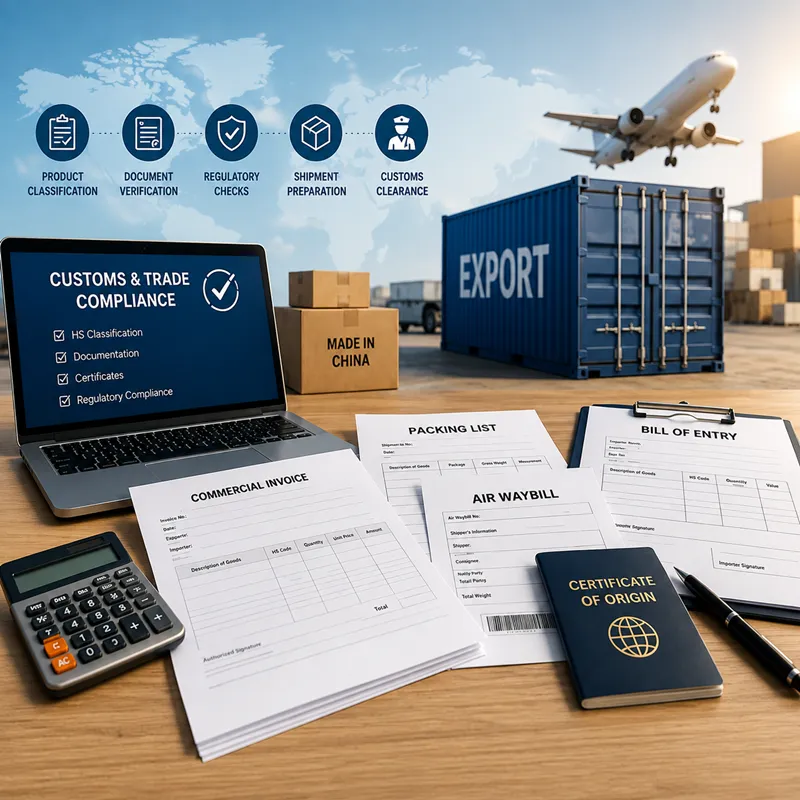
JTUO's customs and compliance workflow emphasizes checking export documentation and cargo information before airport handover. This is especially useful when several Chinese suppliers contribute goods to one consolidated air shipment.
A certificate of origin should contain enough information to identify the exporter, goods, origin and shipment and to connect the certificate with the corresponding commercial records.
| Information | Why It Matters |
|---|---|
| Exporter details | Identifies the party exporting the goods |
| Consignee details | Connects the certificate to the buyer/importer |
| Country of origin | States the claimed origin |
| Product description | Identifies the goods covered |
| HS code where required | Supports classification and origin verification |
| Quantity / gross weight | Links the certificate to physical cargo |
| Invoice number and date | Connects it to commercial documents |
| Transport information | May identify route or shipment |
| Certificate number | Supports verification and traceability |
| Issuer certification | Confirms authorized issuance |
Product descriptions should be specific enough to match the actual goods. Quantity, weight and invoice references should also agree with the other shipping documents.
If one document shows 800 pieces while another shows 850, or if the invoice and certificate use substantially different product descriptions, customs officers may need clarification.
This consistency is particularly important for customs compliance, because origin evidence should support—not contradict—the import declaration.
Common certificate-of-origin errors involve inconsistent descriptions, incorrect origin claims, document mismatches and certificates prepared too late in the shipping process.
Typical problems include:
Wrong or unsupported origin: assuming goods are Chinese simply because the supplier is located in China.
Different product descriptions: the certificate does not match the commercial invoice.
Incorrect quantities or weights: data differs from the packing list or actual cargo.
Wrong invoice reference: invoice number or date is entered incorrectly.
Incomplete consignee information: buyer details differ across documents.
Late preparation: the importer requests the certificate only after cargo has departed.
Another risk occurs in consolidated shipments. Several suppliers may use different product descriptions, invoice formats and origin information, creating inconsistencies when documents are combined.
Using a China-to-India logistics coordination service provides an opportunity to compare supplier records before the final shipping documents are prepared. JTUO coordinates suppliers, warehouse information and export preparation so discrepancies can be identified earlier in the process.
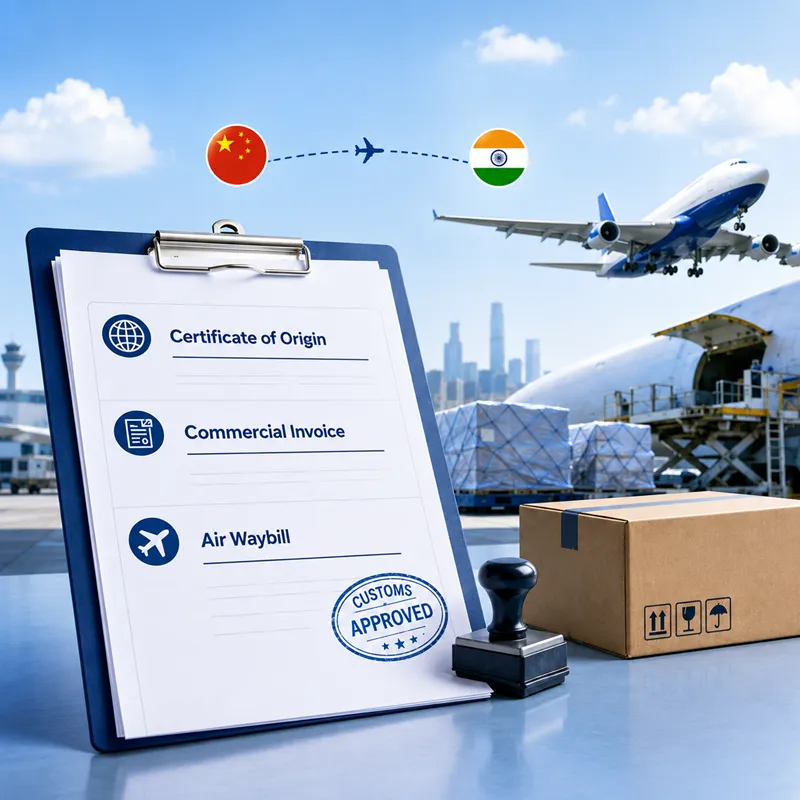
The simplest rule is that the certificate, invoice, packing list and Air Waybill should all describe the same physical shipment.
A certificate of origin in China provides documentary evidence of where exported goods originate, but it is not automatically required for every China-to-India air shipment.
Importers should confirm whether origin evidence is required before cargo leaves China and ensure that certificates of origin match the invoice, packing list and other shipping documents. Correct origin information is also an important part of customs compliance, particularly when origin affects trade-policy or regulatory treatment.
Preparing the certificate early is far easier than resolving origin discrepancies after cargo reaches India.
The certificate of origin meaning is documentary proof that goods originate in a specified country under applicable origin rules.
No. Requirements depend on the product, destination, customs procedure and commercial arrangement.
Authorized issuing authorities can issue certificates, and exporters can also use recognized channels such as CCPIT where applicable.
No. Origin depends on where goods were produced or sufficiently transformed, not simply where they were shipped from.
Yes. Product description, quantity, invoice reference and other key information should be consistent.
Ideally before the cargo enters the final export and airline-documentation process.