 en
en 


Call

Customs and trade compliance means ensuring that cargo, declarations and supporting records satisfy the import, export and regulatory requirements that apply to an international shipment. For China-to-India air freight, compliance should be checked before cargo leaves China rather than treated only as an Indian customs-clearance task.
This matters especially for air cargo because transport is relatively fast. JTUO lists approximately 3–7 days from warehouse receipt to arrival in India for its air-freight service, meaning an unresolved documentation or product-compliance issue can consume a significant part of the total shipping cycle.
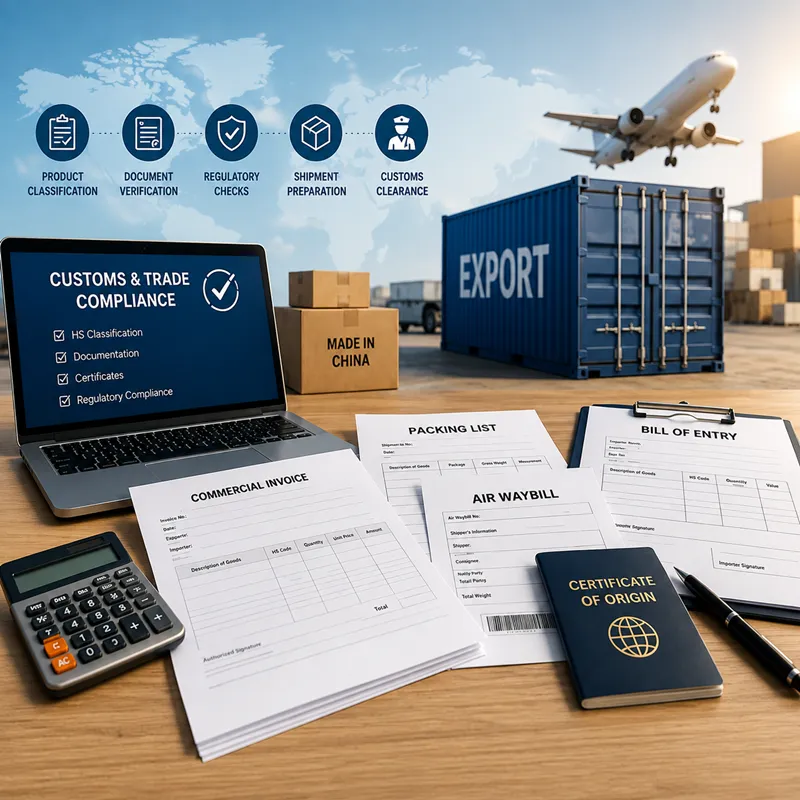
A practical customs compliance process therefore connects product classification, commercial information, regulatory checks and shipment preparation before airline acceptance.
Customs and trade compliance is the process of ensuring that goods, declarations and supporting documents comply with the rules governing cross-border trade.
It involves more than paying import duties. Businesses need to confirm what the product is, how it should be classified, where it originates, whether import restrictions apply and whether the value and quantity declared to customs are accurate.
India's Customs Act Section 46 requires importers presenting a Bill of Entry to ensure the accuracy and completeness of the information, the authenticity of supporting documents and compliance with applicable restrictions or prohibitions.
For China-to-India shipments, good customs and trade compliance therefore involves cooperation between the Chinese supplier, freight forwarder, Indian importer and any customs representative.
JTUO's customs and trade compliance service focuses on pre-shipment documentation and coordination so potential problems can be identified while cargo is still in China rather than after arrival.
Pre-shipment customs compliance verifies that the physical goods and declared information are suitable for export, airline acceptance and subsequent import into India.
Before cargo is delivered to the export airport, the product description should be specific enough to identify what is actually being shipped. Terms such as “parts,” “accessories” or “samples” may be insufficient when the exact material, function or product type affects classification or regulation.
HS-code information should also be reviewed rather than copied automatically from an old shipment. A similar-looking product can have a different classification when its material, function or technical specification changes.
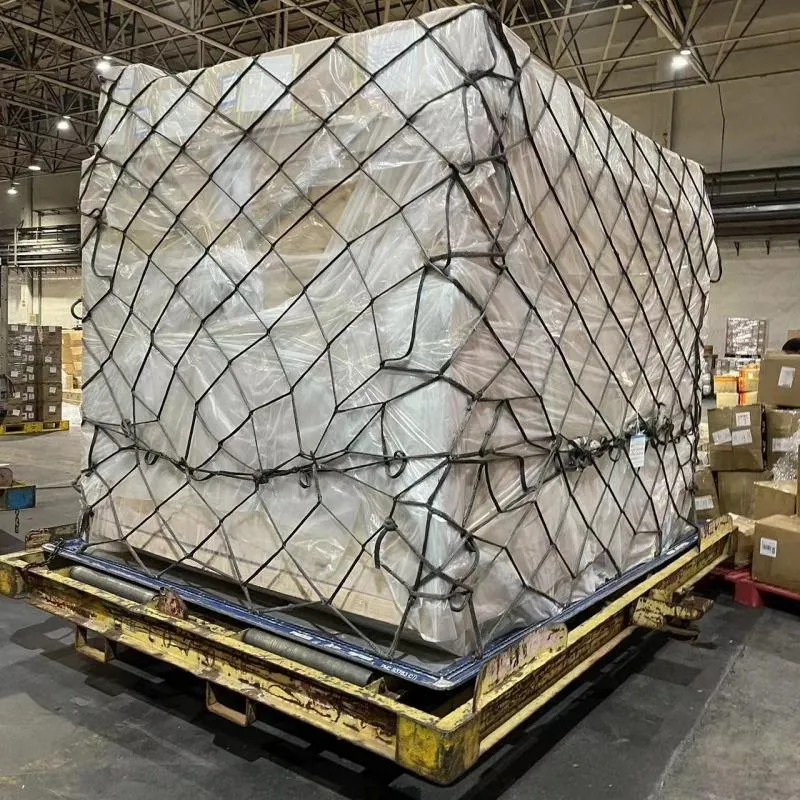
Special cargo requires additional attention. Batteries, liquids, powders, magnetic products and chemicals can affect airline acceptance as well as customs compliance. JTUO's warehouse workflow checks cargo details including quantity, weight, volume, HS-code information and the presence of special items before airport delivery.
For businesses using China-to-India air freight, this pre-shipment stage is the best opportunity to correct information without disrupting the planned flight.
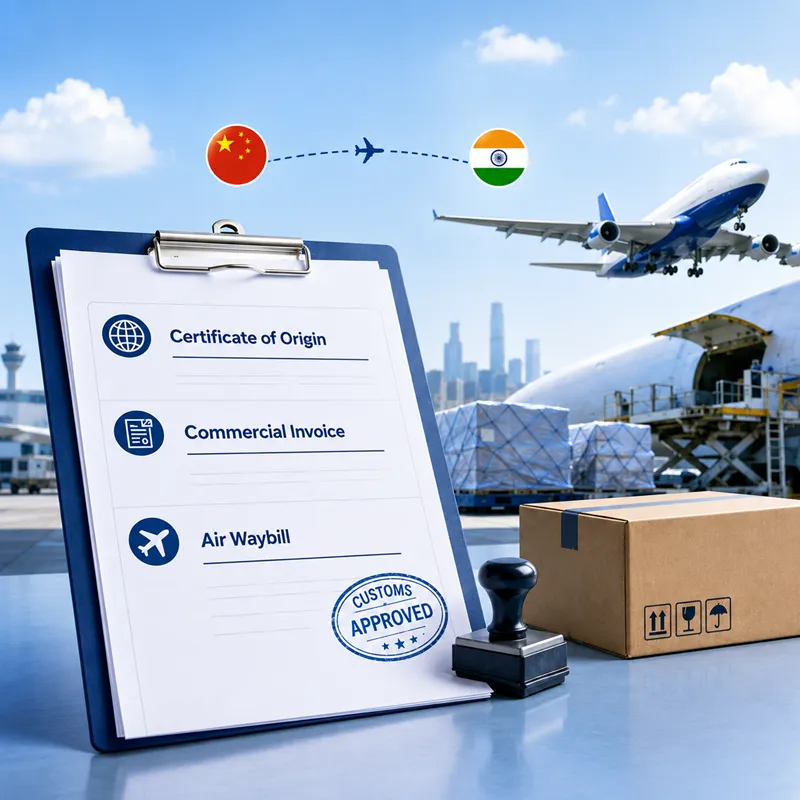
Shipping documents form the documentary evidence used to describe the goods, commercial transaction and transportation arrangement during customs review.
The main documents should support each other rather than contain conflicting information.
| Document | Main Compliance Role | Key Information to Check |
|---|---|---|
| Commercial Invoice | Supports value and commodity declaration | Description, value, currency, buyer/seller |
| Packing List | Confirms physical shipment | Quantity, weight, dimensions, packages |
| Air Waybill | Records freight movement | Shipper, consignee, routing, cargo details |
| Bill of Entry | Indian import declaration | Classification, value, duties, importer data |
| Certificate/Licence | Supports specific regulatory requirement | Validity, product scope, issuing authority |
Freight documents such as the MAWB and HAWB mainly describe transportation, while the invoice and packing list describe the commercial and physical shipment.
The compliance risk arises when these records disagree. If an invoice lists 20 cartons, the packing list lists 22 and the Air Waybill records another weight, customs or airline staff may request clarification.
For consolidated cargo from several suppliers, JTUO's cargo consolidation service can provide an additional checkpoint before final shipping documents and freight documents are completed.
Certificates of origin provide evidence of the country of origin of goods when origin information is required for trade-policy, tariff or regulatory purposes.
Origin is not necessarily the same as the country from which cargo was shipped. A product sent from a Chinese warehouse may contain components or manufacturing processes involving several countries, so origin should be determined according to the applicable rules rather than shipping location alone.
The World Customs Organization explains that rules of origin determine the economic nationality of goods and can affect trade-policy measures, preferential treatment, origin marking and trade statistics. The WCO also notes that certificates of origin are generally required when necessary for preferential treatment or particular trade-policy measures. WCO origin-certification guidance provides additional guidance on these procedures.
For customs and trade compliance, buyers should confirm whether a certificate is actually required for their product and transaction rather than automatically requesting one for every shipment.
The product description, HS classification and origin stated on the certificate should also remain consistent with the commercial and customs records.
Common customs and compliance errors occur when the physical cargo, commercial records and regulatory information do not match.
Frequent problems include:
Vague product descriptions that do not clearly identify the commodity.
Incorrect HS codes copied from unrelated or previous products.
Invoice and packing-list discrepancies in quantity, weight or description.
Undeclared special cargo, particularly batteries, chemicals, liquids or magnetic goods.
Incorrect origin information or unsupported certificates of origin.
Missing approvals for products subject to Indian import controls.
Another mistake is treating customs and trade compliance as something that starts after the aircraft lands. By that point, correcting a supplier declaration, obtaining technical documentation or replacing an incorrect certificate can be considerably harder.
JTUO's practical role is to coordinate suppliers, warehouse information and transportation preparation before departure. This does not replace the Indian importer's legal responsibilities, but it can reduce avoidable inconsistencies before the shipment enters the customs process.
Effective customs and trade compliance for China-to-India air freight starts before cargo leaves China. Product classification, commercial information, shipping documents, origin evidence and regulatory requirements should be checked as one connected compliance file.
A structured customs compliance process reduces the risk that paperwork and the actual cargo tell different stories. For time-sensitive air shipments, resolving these issues before airline acceptance is generally much easier than correcting them after arrival in India.
It is the process of ensuring goods and declarations meet applicable customs, trade and regulatory requirements.
Ideally before cargo leaves the supplier or enters the export airport process.
No. Freight documents support transportation but do not replace commercial and customs records.
No. Requirements depend on the goods, trade measures and whether origin evidence is needed.
The importer has important legal responsibilities for the accuracy and validity of the import declaration and supporting documents.
Incorrect classifications, inconsistent documents, vague descriptions and missing regulatory information are common causes.